Dear reader,
There is a small moment every morning when the world has not yet entered the room.
Your obligations are still waiting. The messages have arrived, but they have not yet been opened. Nobody has explained what is urgent, what is wrong or what deserves your attention.
For a few minutes, your mind is still yours.
Most of us surrender that moment almost immediately.
We reach for the phone before both eyes are properly open. One message leads to an email. The email reminds us of a task. The task produces tension. A headline introduces a problem we did not know existed. A short scroll quietly becomes twenty minutes of other people’s lives, opinions and urgency.
By the time our feet touch the floor, the world has already chaired the first meeting of the day.
This is not an argument against technology. The phone is a tool, and often an excellent one. It is an argument for sequence.
The brain is the organ.
The mind is its activity.
The brain is a physical organ. It is living tissue with structures, cells, blood supply and measurable electrical and chemical activity. The mind is the name we give to mental activity and experience: thought, attention, memory, interpretation, imagination and feeling.
In Evolve Your Brain, Joe Dispenza offers the memorable phrase, “the mind is the brain in action.” It is useful as an introduction, although the scientific and philosophical relationship between brain, body, environment and conscious experience is more complex than one sentence can contain.
For HYPERSTETIX, the practical distinction matters.
The brain is supported through the body. Sleep, movement, hydration and nutrition all matter. We will give those subjects their proper place in the BODY sphere.
Here, we are concerned with what nourishes the mind.
Information is one of its primary inputs.
Conversations are inputs. Images are inputs. Music, headlines, books and private self-talk are inputs. The stories we repeat about our past are inputs. So are the people whose voices we allow to remain in our heads long after they have left the room.
What we consume is not limited to what is on the plate.
The startup
sequence.
The computer is not a complete model of the human mind, but it gives us a useful picture.
When a computer is starting, we allow it a moment to load its essential processes. We do not type furiously, open twenty programs and then complain that the system has frozen.
Human beings are not machines, but waking is also a transition. Research describes a period called sleep inertia, when alertness and some aspects of performance are still recovering after sleep. Its duration varies, and it does not mean that the mind is dangerously fragile in the morning. It simply reminds us that waking is a process, not an instant switch.
Yet this is precisely when many people introduce maximum stimulation.
Some of these act primarily on attention. Others act through the body and its arousal systems. Together, they can turn a quiet transition into an immediate reaction.
The problem is not that one morning scroll ruins the brain. That would be dramatic, memorable and scientifically careless.
The subtler problem is that it trains a sequence.
Wake. Reach. Receive. React.
Before we decide how we want to feel or what matters today, external demands have made the opening move.
Begin
by choosing.
A healthier morning does not need to involve a five o’clock alarm, an ice bath and a personality transplant.
It also does not need to look spiritual, athletic or impressive on Instagram.
It needs to help you enter the day deliberately.
Drink water. Open a window. Watch the sunrise. Pray. Practise gratitude. Read two pages of a book. Put on quiet music. Stretch. Walk. Dance badly in the kitchen. Kiss your partner. Hug your child. Sit for three minutes without asking the world what it wants from you.
Choose something that makes you feel present, grateful or gently alive.
The ritual is personal. The principle is not.
Begin by choosing.
There is something quietly powerful in treating the first part of the morning as a celebration of life rather than the beginning of another negotiation with it.
This will not guarantee a perfect day. A composed morning cannot prevent an unpleasant email, a difficult meeting, traffic, illness or other people behaving like other people.
It can, however, give you a more intentional starting position.
From reaction
to authorship.
The goal is not to become permanently positive, unreachable or emotionally polished.
The goal is to make the mind more proactive and less automatically reactive.
A proactive mind does not control reality. It creates enough distance from the first impulse to choose the next response. It can notice stress without immediately becoming stress. It can receive information without allowing every piece of information to become a command.
This is where morning practice connects with restoring human agency.
The first victory is not productivity. It is authorship.
You decide which thought receives rehearsal. You decide which voice receives authority. You decide whether the first minutes of the day belong to your values or to the nearest notification.
The HYPERSTETIX
cycle.
Mind, body, environment and relationships do not operate as separate departments.
They form a cycle.
The body supports the brain. A healthy environment gives attention room to settle. A clearer mind makes better decisions for the body, the environment and the people around it. Repeated decisions gradually become the architecture of a life.
When one sphere improves, it can make the next improvement easier.
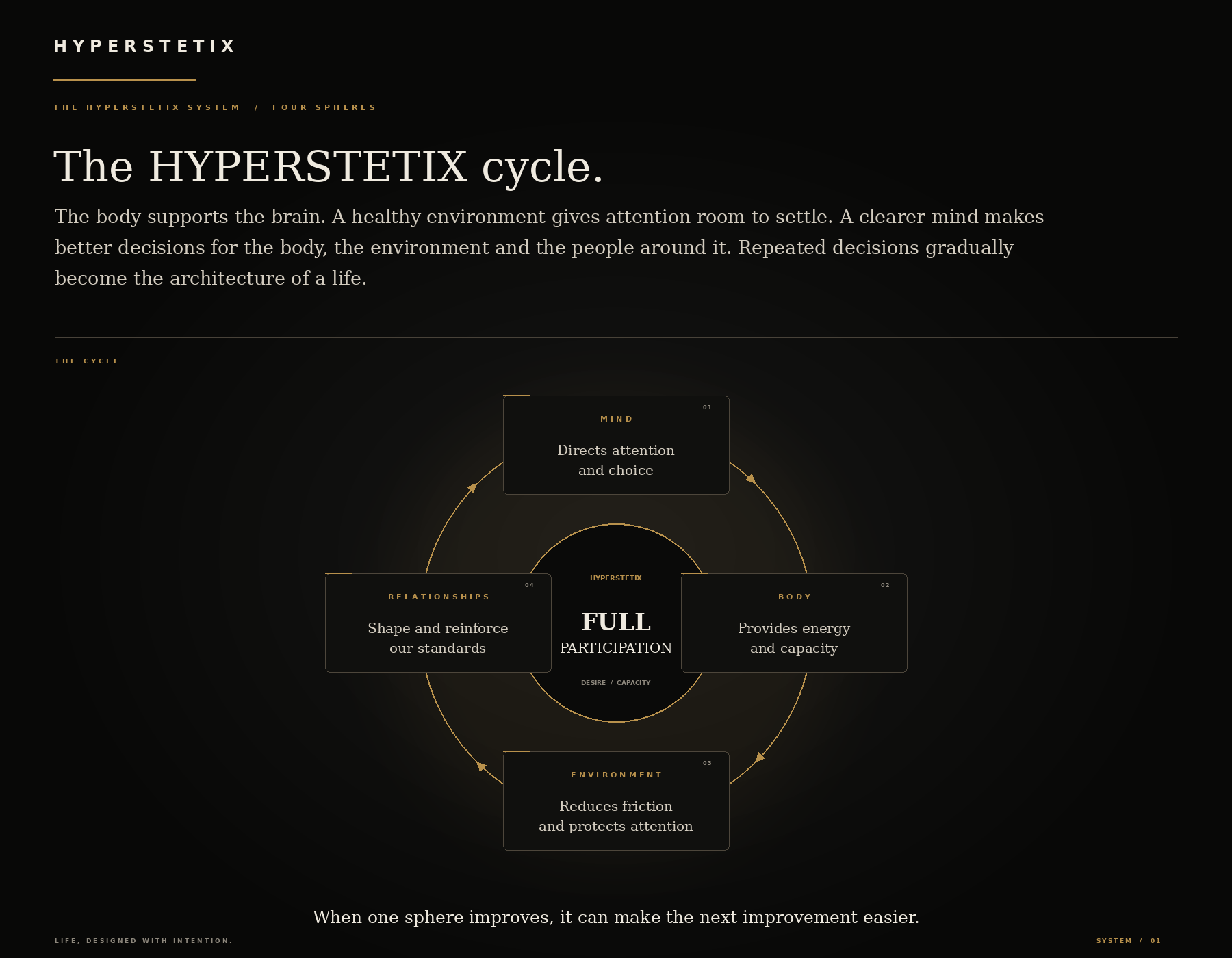
Drink water and move, and the body becomes more available. Clear the room, and the mind meets less friction. Protect the first information of the day, and attention has a better chance of serving what matters. Choose better actions, and the environment begins to reflect a different standard.
This is not magic. It is sequence.
A strong mind does not simply “attract” everything good. It becomes more capable of noticing opportunity, rejecting unnecessary noise, making deliberate choices and remaining available for the life already in front of it.
Life will still send messages before breakfast.
The point is not to hide from the world.
It is to meet yourself before the world occupies you.
TOMORROW MORNING